

TL;DR
- Austin rents are down and renters have leverage — the metro saw the steepest rent decline of any large U.S. city from 2021–2026.
- The cause is a historic supply wave, not collapsing demand — Austin's population kept growing through the drop.
- Don't read the metro number as the 78745 number: South Austin has been a more resilient pocket.
- Fall is historically a softer renting season, which adds to your negotiating room.
- SOFI at 6311 is a 2025-built South Austin community. See current availability.
Austin rents are falling, and they have been for nearly two years. As of early 2026, the metro's median rent sat below the national average after one of the steepest multi-year declines of any large U.S. city — driven by a record wave of new apartment construction, not weak demand. For renters, that means real negotiating power heading into fall 2026. But the metro-wide number hides an important split: resilient submarkets like South Austin's 78745 have held up far better than the citywide average suggests. Here's what's actually happening, and what it means for your next lease.
Are Austin rents going up or down in fall 2026?
Down. Austin's rents have declined for nearly two years and remain soft heading into fall 2026. Realtor.com data reported by KUT put the metro's median asking rent at about $1,357 as of February 2026 — down more than 7% year-over-year and roughly $300 below the September 2022 peak. The Pew Charitable Trusts put the January 2026 median around $1,296, below the U.S. median.
The driver is supply: Austin delivered a record wave of new apartments, pushing vacancy up and rents down even as the population grew. This is a supply correction, not a demand collapse.
Which Austin neighborhoods have the most competitive rent right now?
The deepest discounts cluster where the most new supply landed and in older Class C buildings. Pew found rents in older non-luxury (Class C) buildings fell about 11%, the steepest cuts in the market. New Class A communities, meanwhile, compete with concessions rather than deep base-rent cuts.
Here's the metro-versus-submarket picture:
| Market | Approx. median rent (early 2026) | YoY trend | Source |
|---|---|---|---|
| Austin metro (all unit types) | ~$1,296–$1,357 | Down ~7% YoY | Pew; Realtor.com via KUT |
| U.S. median (reference) | ~$1,353 | Roughly flat | Pew |
| Class C (older, metro) | — | Down ~11% | Pew |
| South Austin 78745 (1-bedroom) | ~$1,356 | Down YoY | RentHop (May 2026) |
| South Austin (occupancy) | Above 94% (Oct 2025) | One of only two Austin submarkets above 94% | RealPage |
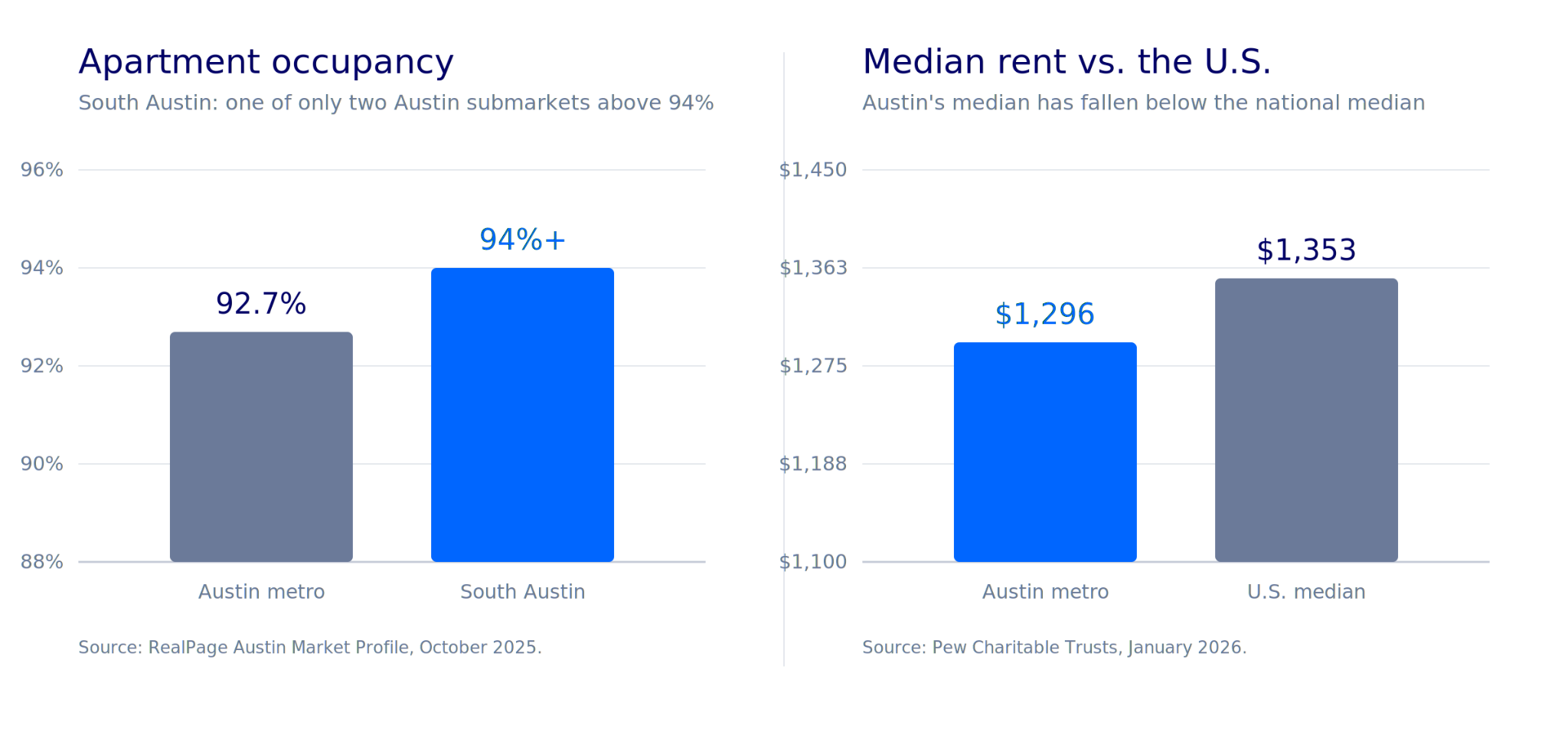
The occupancy gap is the clearest proof: as of October 2025, RealPage reported South Austin held above 94% occupancy — one of only two Austin submarkets to do so — while the metro overall sat at 92.7%. South Austin also saw fewer new deliveries than the heavy-supply corridors, which is a big part of why it held up. Unit-level 78745 figures move with current listings, so pull the latest from a named source before citing a specific number.
Is South Austin more affordable than North Austin?
It depends what you're optimizing for. The deepest concessions right now sit in the heavy-supply north corridors — Domain-area communities have advertised 8–10 weeks free to fill units. But “most concessions” isn't the same as “best value.” South Austin offers commute access, airport proximity on the same side of the river, and a more resilient rent base, which is why the 78745 submarket has held up better than the metro headline.
The key point: don't read the metro-wide decline as the South Austin number. The citywide narrative gives underperforming properties cover; 78745 has been the more stable pocket — RealPage data shows South Austin among the few submarkets that held above 94% occupancy while the metro slipped to 92.7%.
Is fall a good time to rent an apartment in Austin?
Generally, yes — and 2026 amplifies it. Fall is historically a softer leasing season after the summer rush, so leasing offices have more empty units to fill and more reason to deal. Layer that on top of the current oversupply and renters have unusual leverage: concessions, waived fees, and flexibility on terms. If you're shopping this fall, calculate net-effective rent (base rent minus free months spread across the lease) before comparing options.
How does the Austin rental market compare to the national average?
Austin now sits below the national median. Pew reported Austin's January 2026 median rent at roughly $1,296 versus a U.S. median around $1,353 — a notable flip for a city that, in late 2021, was running about 15% above the national median. In other words, Austin went from meaningfully more expensive than the typical U.S. metro to slightly cheaper, in the span of a few years.
The Buda/Kyle signal
One more data point that reframes South Austin's value: communities 15–20 minutes south in Buda and Kyle are now priced where parts of South Austin sat a few years ago. That compression means staying in a well-located South Austin ZIP no longer carries the premium it once did over the far-south suburbs — you can be closer in without paying far more.
What it means for your next lease
If you're renting in Austin this fall, the market is on your side — but read it correctly:
- Negotiate. Ask for concessions and compare on net-effective rent, not sticker rent.
- Don't overweight the metro headline. A resilient submarket like 78745 won't show the same fire-sale pricing as the most oversupplied corridors, and that stability is a feature, not a markup.
- Move while leverage lasts. Analysts expect the market to tighten back toward balance as construction slows, so the renter-favorable window has a shelf life.
SOFI at 6311 is a 2025-built Class A community in the 78745 submarket, with studio, one-, and two-bedroom floor plans. See current availability and check the neighborhood before you decide.
Frequently asked questions
Are Austin rents going up or down in fall 2026?
Down. Austin rents have fallen for nearly two years; the metro median was around $1,296–$1,357 in early 2026, down roughly 7% year-over-year and well below the 2022 peak, driven by a record supply of new apartments.
Why are Austin rents falling?
A historic wave of new apartment construction pushed vacancy up and rents down. It's a supply correction — Austin's population kept growing through the decline, so it's not a demand collapse.
Is South Austin's 78745 as cheap as the metro average suggests?
Not exactly. The metro-wide decline is steepest in heavy-supply corridors and older Class C buildings. South Austin's 78745 has been a more resilient submarket, so it doesn't show the same deep discounts — that stability is part of its value.
Is fall a good time to rent in Austin?
Yes. Fall is historically a softer leasing season, and combined with current oversupply, renters have strong leverage on concessions and terms. Compare net-effective rent before signing.
How does Austin rent compare to the national average?
Austin's median rent (around $1,296 in January 2026) is now below the U.S. median (around $1,353) — a flip from late 2021, when Austin ran roughly 15% above the national median.
What is net-effective rent and why does it matter now?
Net-effective rent is your true monthly cost after spreading any free months across the lease term. With concessions widespread in Austin this fall, comparing net-effective rent — not sticker rent — is the only accurate way to compare options.
Should I rent in South Austin or the northern suburbs for the best deal?
The deepest concessions are in the heavy-supply north, but South Austin offers commute access, airport proximity, and a more stable rent base. The best “deal” depends on whether you're optimizing for raw concession size or location and stability.


